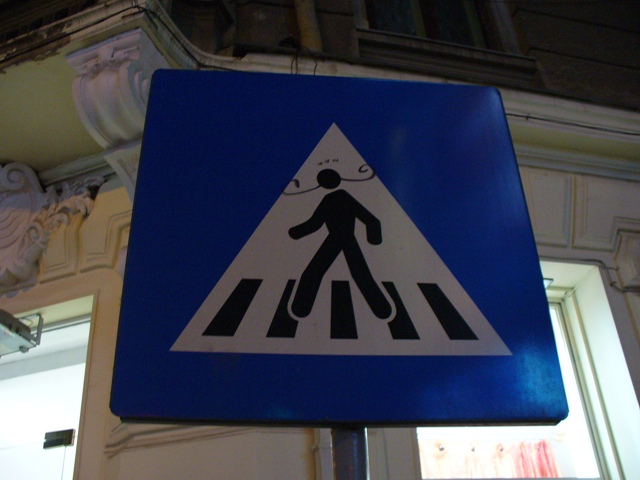
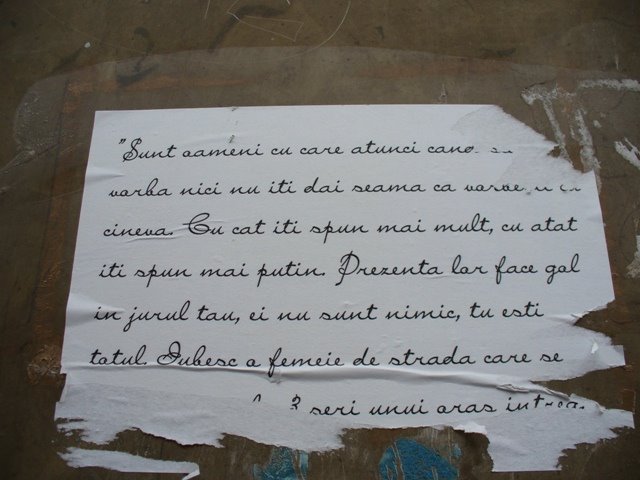
 i have this weird habit of paying attention to practically everything on the street. which sometimes translates into the more weird habit of observing all sorts of stains, asphalt deviations, shadows and so on in order to make something out of them. i somehow consider this to be a good exercise for my imagination, even though i sometimes get carried away and reach quite outrageous associations. but, after all, this can be regarded as a form of street art itself, can't it? or maybe, better said, street's art?
again, some posting on details. The thing i adore about "The tipping point" is that it presents all sorts of psychological experiments, habit probably derived from Malcolm Gladwell's admitted obsession for psychology. One of these experiments particularly caught my attention because it immediately made me think about some recent TV commercials. A large group of students were recruited for what they were told to be a market research study by a company developing high-tech headphones. Each of them was given a headset and was required to listen to various tracks, dance and move their heads up and down, presumably in order for the company to see how well they worked when the listener was in motion. But there another flick involved, and that was the actual purpose of the experiment. The students also heard a radio editorial arguing that tuition at their university should increase from the current level of $587 to $750. A third of the participants in the experiment were previously asked to nod their heads up and down vigorously when they would hear the radio editorial, another third were instructed to shake their heads from side to side and, finally, the last third was told to stand still. At the end of the test, the students were required to fill in a questionnaire that slipped the question: ”What do you feel would be an appropriate dollar amount for undergraduate tuition per year?”. The students who kept their heads still were unimpressed by the editorial – they indicated something like $582, which was pretty much the same level with the current level. Those who shook their heads from side to side wanted tuition to fall to a level of $467, thus reacting negatively to the increase proposal in the editorial. On the other hand, those who nodded their heads up and down agreed with the proposal in the editorial and suggested an increase of the tuition, even though it meant giving money out of their own pockets. For further details, consult the book directly.
But among others, one of the conclusions of this experiment, as expressed by Gary Wells of the University of Missouri was that “television advertisements would be most effective if the visual display created repetitive vertical movement of the television viewers’ heads.” If we extrapolate, that might mean that television advertisements are less effective if the visual display creates repetitive horizontal movements equal to nodding from side to side in disagreement.
And that made me think about some recent Ariel (please correct me if I’m wrong about the brand) commercials, which consisted of people moving their heads from side to side in order to follow various objects (like a tennis ball etc). I just wonder if and how the results of the previously quoted experiments apply.
now, i am not a psychology or manipulation freak, who only believes in and spots all sorts of subliminal techniques and all that, although i do not dismiss them either. What i do strongly believe in (in case this blog hasn't already made it obvious), however, is that "Little things can make as much of a difference as big things" and that "the subtle circumstances surrounding how we say things may matter more than what we say". Which might mean, as Gladwell further puts it, that "simple physical movements and observations can have a profound effect on how we feel and think", because "Persuasion often works in ways that we do not appreciate. It’s not that smiles and nods are subliminal messages, it’s just that they are incredibly subtle."

 this is what i see daily when entering my office. honestly, it freaks me each time i look at it.
 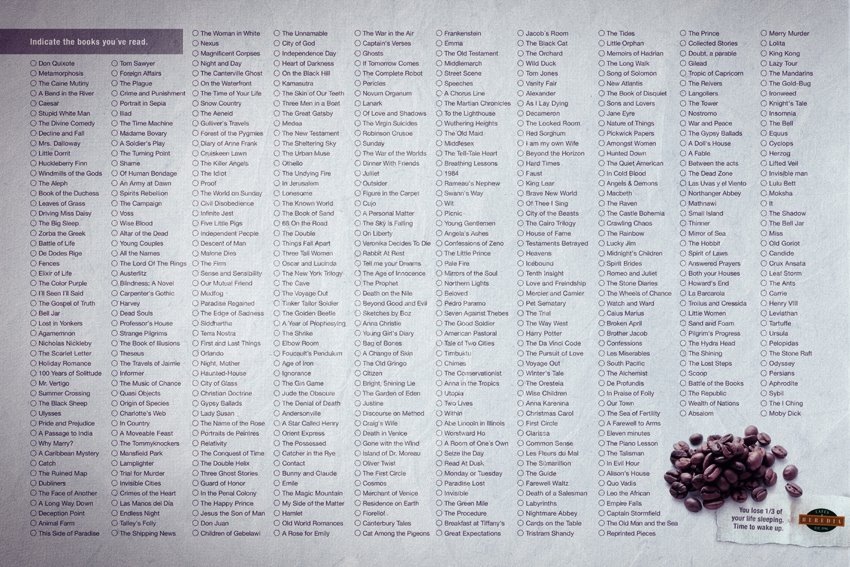 These ads were developed by Leo Burnett Lisbon for Heredia coffee. Their message -"You lose 1/3 of your life sleeping. time to wake up."- is transmitted by presenting people long lists of books they've likely never read, although they should have, or places they've likely never been to, although they should have. Which i liked. It reminded me of Jonathan Coe's "House of Sleep". With a special dedication to my sister. via adrants.

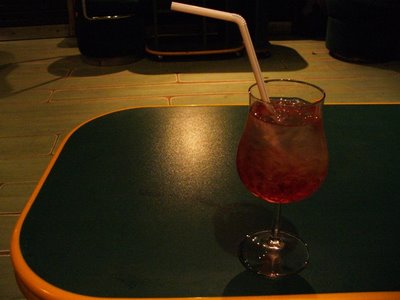
then i had a weird lemonde in Green Hours. it was weird cause it contained far more curacao (or something) juice than lemon juice, which made the term "lemonade" the waiter used quite overpromissing.
parks are really sad when there's practically nobody around. children's playgrounds without children giggling seemed lonely in the "loneliness of the long-distance runner" sense. it that makes any sense.

 and i noticed this on Eminescu, as i was heading to the office.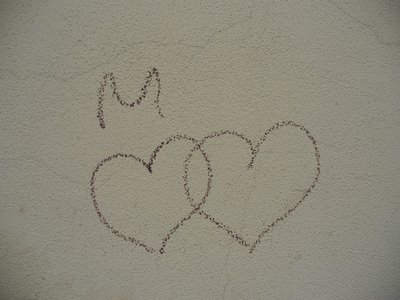
the best part of the day however, was that i bought myself some great books, and i found some new interesting comics, and i also found some video tapes featuring Rahan and Tintin. Enough for now, more posting will come as i actually start reading the books.

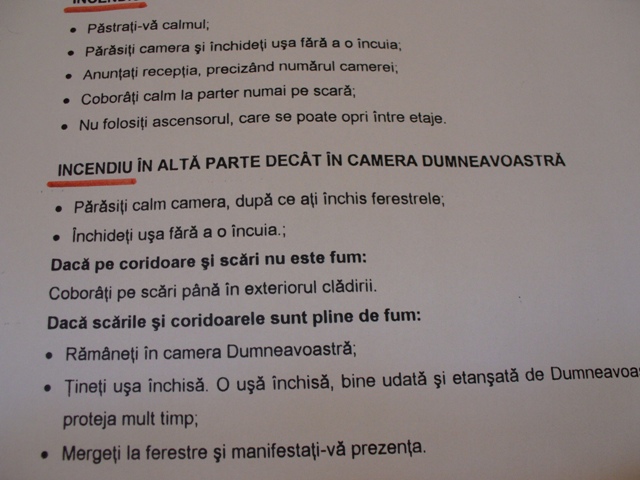 these instructions were on my door in a Predeal hotel. For some reason, i felt the need to share them.