Showing posts with label books. Show all posts

29 Jul 2008

seriously, now

some time ago, i read A. Plesu's "Tescani Diary". the reading was enjoyable and thought-provoking, and there were several ideas i particularly embraced. one of them said that "the act of thinking should start by taking a platitude seriously. starting from a platitude is equivalent to starting without a personal idea. the people who have ideas too fast, who have ideas even from the beginning, almost always end up not trully thinking. the key to optimal speculative start-up: not having ideas, but rather obtaining them."

i love the idea of taking a platitude seriously. i work in an environment that cannot work with presumably "general ideas": we fear not being particular enough, so we'd rather invent or fabricate something (a benefit, most of the time), than taking "general ideas" seriously and communicating them differently to people, embracing a new perspective and shading a whole new light on them. and that's a pity: in my opinion, most "general ideas" are general because everybody takes them for granted and nobody actually takes the trouble to go deeper into finding out what these ideas actually mean, what they actually translate into. although showing a brand new meaning of a "general idea" is very impactful and intriguing, because it makes people think: "hey, i never looked at it this way".
pic from here.

6 May 2008

hammock braindead

I must admit that the very short but lovely holiday i had last week brought at least a new passion for me: the hammock. I have experienced sleeping outdoors before, in various types of beds and grass, but hammocks are different in a way that i wouldn't have expected. They must be the most relaxing way of enjoying sun and warm weather ever. And because they're so relaxing, i realised u simply cannot read any type of book while endlessly bouncing around, with the sun and friendly wind blows and life actually feeling good and everything. i tried to read "serious" or rather technical stuff, and it was in pure vain.

so i resorted to reading a book i completely accidentally bought. it's called "it's just you, everything's not shit" and is written by steve stack. obviously, such a title would never have attracted me, but sometimes a book does simply cry to be taken from the shelf, and that's pretty much how i ended up buying this one some time ago. this proved to be a wise choice, because the book is really nice and heart-warming. skipping cliches or patronizing pieces of advice, the book simply alphabetically lists common nice things that make our life more beautiful and exciting. the simple things that we often take for granted or forget about, even though acknowledging or remembering them definately makes us smile and droole. As some Amazon reviewer said, the book "manages to delight and inspire without ever resorting to sentimentality". and it's also ocassionally funny, as well as ocassionally filled with interviews from very cool people, such as the founder of the Cloud Appreciation Society, the inventors of eglu or the man behind librarything. it's so great to find a book that you know will always be enjoyable to flick.

pic from here.

14 Apr 2008

printed storytelling

I love reading story-books, but i must admit i haven't come across a book that is as beautiful as "The invention of Hugo Cabret" in a long time. And i'm not saying this only because the story itself is interesting, but also because the book is a wonderful combination of impressive visuals and text that complete each other, instead of plainly illustrating each other, as the case with common children's books. Besides, the human touch of the hand-made drawings makes reading this book a very special and cosy experience. If you come across it, you'll surely enjoy it :).


30 Mar 2008

why so ?

since i've received the book from a very dear friend, i've recently read james frey's "a million little pieces", the diary of a drug addict fighting his addictions. i pretty much enjoyed frey's style, which was equally fast enough to capture quickly, and tourmenting enough to leave a trace in the mind of the reader.


what i couldn't believe, however, was reading about all the controversies surrounding this book. frey published the book as a memoir book, leading everybody to believe that he was one and the same with the main character of his book. however, at some point, it was revealed that he had augmented some of the incidents in the diary, by describing them at a dimension they never actually had in real life. The public incarceration was taken so far, that in 2006, Frey and publisher Random House, Inc. reached a tentative legal settlement, where readers who felt that they had been defrauded by Frey's "A Million Little Pieces" would be offered a refund.


the reason why i am so puzzled is because whenever reading a memoirs book, i assume that not everything there happened exactly as illustrated in the book, because otherwise it would have seemed more like a newspaper article, than the diary of a person going through a lot. and the reason why i am interested in a memoirs book is because it offers me an insightful perspective of how a certain person perceives his/her life experiences, more than it offers me a very accurate recollection of some episodes in his/her life, which i could maybe access by simply reading a biography written by somebody else. are we supposed to be that offended if a writer inserts some fiction when writing his memoirs ?

10 Jan 2008

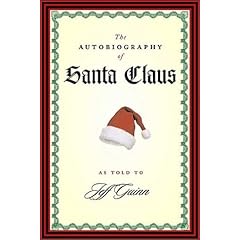
saint nick as told by


i spent my holiday in seciu, a small village situated on a hill near Ploiesti. and it was a very relaxing holiday, mostly because it was filled with reading, watching movies, interacting with people who have a completely different lifestyle (also trying to adapt to their lifestyle) and exercising.


The main reason why i wanted to stay away from cities was the commercial holidays syndrome that drove me completely crazy. While i was really nostalgic about the nice recollections of cosy times of holidays beautifully spent together with my family and close friends, decorating, singing carols, being excited about the Xmas tree and Santa and all that. So i tried to recreate that holiday cheerful atmosphere.


And part of the attempt was reading this book called "The Autobiography of Santa Claus" and written by Jeff Guinn. I must admit i was completely fascinated by the contruction of the tale. The book combines lots of historical information with lots of fiction, and the result is a nice voyage through time, that explains each magical aspect related to Santa (that is, nearly all aspects that make his existance improbable) in a rational way. Well, kinda rational. In the sense in which you're willing to admit that Nicholas has used all opportunities history provided in order to team up with people such as Attila, Arthur, Leonardo da Vinci (in case you ever wondered who designed the flying sleigh) or Benjamin Franklin, with whom he now shares the North Pole headquarters. And that's just a glimpse of the story, which is obviously not delivered in a "theory of conspiration" manner, but rather in a "whatif" joyous manner. And since winter holidays have the gift of allowing imagination to drift as much as possible, this was a really relaxing read, especially accompanied by fresh orange tea and ginger biscuits :).

13 Nov 2007

status anxiety

I only recently came across Status Anxiety from Alain de Botton (came across actually means that sergiu pointed it out). And i must admit i really enjoyed it, because it's a very interesting theory (part of which i myself was explaining when talking about the new suburbias of Bucharest), even though the alternatives he suggests to the status-driven never-ending anxiety are quite soft and not necessarily widely-embraceable.

"This is a book about an almost universal anxiety that rarely gets mentioned directly: an anxiety about what others think of us; about whether we're judged a success or a failure, a winner or a loser. This is a book about status anxiety.

We care about our status for a simple reason: because most people tend to be nice to us according to the amount of status we have (it is no coincidence that the first question we tend to be asked by new acquaintances is ‘ What do you do?’). With the help of philosophers, artists and writers, the book examines the origins of status anxiety (ranging from the consequences of the French Revolution to our secret dismay at the success of our friends), before revealing ingenious ways in which people have learnt to overcome their worries in their search for happiness. It aims not only to be entertaining, but wise and helpful as well."

22 Oct 2007

oxford murders

very interesting weekend for me, although i basically spent it in my bed, reading and solving math problems (while also not being able to hear anymore with my left ear).


the reason why it turned out to be interesting, despite its monotony, is because i read a book called "The Oxford Murders", written by Guillermo Martínez, an Argentinian writer who also has a PhD in mathematical logic. The book deals with a series of murders which appear to follow a mathematical pattern - which is why the people who seem most likely to solve them are a logics professor together with a math scholar. When i started reading the book, i did not know what to expect, especially since i feared it might be just one more of those many silly recent books which attempt to seem serious and interesting by inserting completely ridiculous mathematical codes references. Instead, it's a pleasurable reading referencing ones of the most important and challenging theories in maths, logics and even physics (Gödel's incompleteness theorem, Fermat's last theorem, Wittgenstein's Finite Rule Paradox and even Heisenberg's Uncertainty Principle). And what seemed even more enticing to me is that the book manages to somewhat explain these concepts in a very simple way: it becomes clear how "any finite sequence of numbers can be a continued in a variety of different ways - some natural, others unexpected and surprising, but equally valid". Actually, the thing i appreciated the most is that the book seemed to me a very good highschool textbook, more than a detective novel. With the crime story as a pretext to exemplify the concepts. Which is probably why i got completely hooked and i spent a lot of time remembering all sorts of maths/logics talks i had during highschool, as well as actually solving some problems.

13 Mar 2007

you're getting a little cuckoo, viskovitz

I have recently read a book called "You are an animal, Viskovitz", which i loved for a number of reasons.


It may sound funny, but the first thing that attracted me was the writer's biography, which i'll try to translate from the book's cover. Cause his story is really interesting in quite a literary character sense. Alessandro Boffa was born in Moscow and worked for two years as a biologist in an animal genetics lab. He further dedicated himself to the study of the human brain. During the financial crisis in 1986, he won a considerable amount of money on the stock and left to California and Eastern Asia, where he remained for eleven years. Then, he got a degree in gemology in Bangkok, and started doing business with gems, after which he spent five years on a small island in Thailand. He wrote "You are an animal, Viskovitz" in 1998, and had great success with it.


Then, the second reason i liked it is the fact that i think it's a great book for planners - cause the reader is offered so many different perspectives on the world, each subjected to different rules, different "cultures", different social constraints. This happens cause the reader is invited to step into Viskovitz's shoes, who "reincarnates" into 20 different creatures, each of them featured in a different short story. And of course, the hilarious fables are actually insights into the human nature.
Switching to the third reason, i must say i totally love the books that don't really end with the last page, but inspire you to look for something else as well. And that's what happened with this one - its language is very biology-playful, combining scientifical terms with very common terms in quite a funny way (Boffa is a biologist among others, and that's kinda obvious in the book). Which made me go straight away to a book shop and buy some biology scientific book. It's really nice when some joke helps you start learning something a bit more serious.
And, last thing which comes in my mind right now - it reminded me about a book i read and adored when i was in the second grade. The book's called "Instantanee din viata animalelor" (i guess it would be something like "Snapshots from animal life") and it was written by Ionel Pop in 1963.

15 Jan 2007

judgement and planning in chess

"Planning" is a very common word, and it's used in basically all fields. Which is why one of the things i find extremely interesting is to look at other fields and try to figure out certain particularities of their form of planning, which might help me understand my role better, and make more out of it.

I am currently reading an absolutely fascinating book called "Judgement and planning in chess", written by dr. Max Euwe. The book is a wonderful introduction in the complexity of the phenomenon called chess, cause chess is obviously much more than a simple strategy game. With a number of legal positions estimated somewhere between 1043 and 1050, and with a game-tree complexity of approximately 10123, chess offers an enourmous amount of possibilities to seriously challenge one's mind. And the more you practise, the more absorbed you get.
The following extract is the introduction of the book, which i particularly liked for its description of "planning" in chees: "Often when a player has a fair understading of the principles of chess and can make quite pretty combinations, two or three moves deep and occasionally, in simple positions, even four, he suddenly notices, as he meets stronger players, that his development seems to have come at a standstill. He loses games without being able to asses the cause. He works out a series of moves as far ahead as he possibly can and then notices that his opponent has planned it and though it in an entirely diferent direction; in short, he loses the grip on the game which he had possessed at a previous stage. He learns opening variations by heart without accurately knowing why just these moves are played, with the result that he finds himself in totally unfamilia positions - positions which may well be favourable though he has neither any idea why they are so nor knowledge as to how to turn them to his advantage.
A new element enters the chess battle at this stage - namely "positional understanding". It does not grow of itself but must be developed by the process of drawing conclusions in practical play.It represents the increasing ability to form a judgement on any position whatever without going into details of exact calculation.
Just like the doctor, who first has to gain a clear picture of the diseased condition in order afterwards to plan the process of the cure - diagnosis, treatment - the chess player must malke a plan on the basis of such characteritics as he has found in the examination of a given position. Steinitz' axiom that the plan to me made must be in keeping with the characteristics of the position appears self-evident to us, for it is the logical outcome of our present method of taking effective action, though sixty years ago Steinitz' stipulation created a very revolution in chess thought.
Judging and planning. Coming back to our remarks on opening variations, we find that the theoretical work judges for us, generally by means of such symbols as + - =, etc. But this judgement in itself is not enough: we have to know not only which of the two players stands better, but also why. And with this the first step is taken, on the basis of Steinitz' axiom, towards the making of a plan. The forming of a judgement, and the making of a plan, are the topics to be dealt with in this book. They form for the beginner, the bridge, that takes him across to those higher regions where not impulse but reason determines the choice of a move without, however, minimising the significance of what we call "intuition"."